Care in Conversation: Thinking in Practice

Care in Conversation: Thinking in Practice course logo

Care in Conversation: Thinking in Practice is a four-session philosophical course that helps you think more deeply about the often-hidden dimensions of your work and why critical thinking can have such impact in social care practice and leadership.

Each 90-minute session takes a powerful philosophical idea and brings it to life in conversation. They offer a rare kind of learning experience, one where you get to read alongside others, share your understanding, and talk together about the ideas that arise. You’ll find yourself thinking together with a level of depth and imagination that can be hard to find in everyday practice.

We will explore:

  • Why and how thinking matters
  • Human nature and what it means for leading others
  • Justice and freedom as lived experience
  • Authority and how we use it
  • Negotiating principles and practice
  • Modelling reflective, thoughtful cultures in teams
  • Resisting the treadmill and retrieving meaning

You’ll leave with a ‘thinking toolkit’ to bring into supervision, team discussions, and everyday decision-making: the curiosity to ask helpful questions, the confidence to pause and think before reacting, and a clearer sense of the tensions at play in situations.

Participants often tell us that this way of learning stays with them long after the sessions end, helping to renew motivation and a sense of purpose. They also tell us that, even when ideas are challenging, the sessions are inspiring, highly enjoyable, and a welcome change from the pressures of daily practice.

‘It’s made me realise that I need to take time to think decisions through more and not manage in a reactive way.’

— Participant, 2024

If you’re looking for a different kind of learning experience, we’d be delighted to welcome you.

Holding on to Our Values

Holding on to Our Values cover

Holding on to Our Values a CareKnowledge Report: Dr Neil Thompson considers the role that values play as the bedrock for effective social care practice; how they keep us human, how they keep us motivated and on track, and how we can keep sight of them.

“Over the years, many people have made the mistake of seeing values as abstract, philosophical matters and therefore assumed that they are largely unconnected with actual practice. In reality, though, nothing could be further from the truth.”

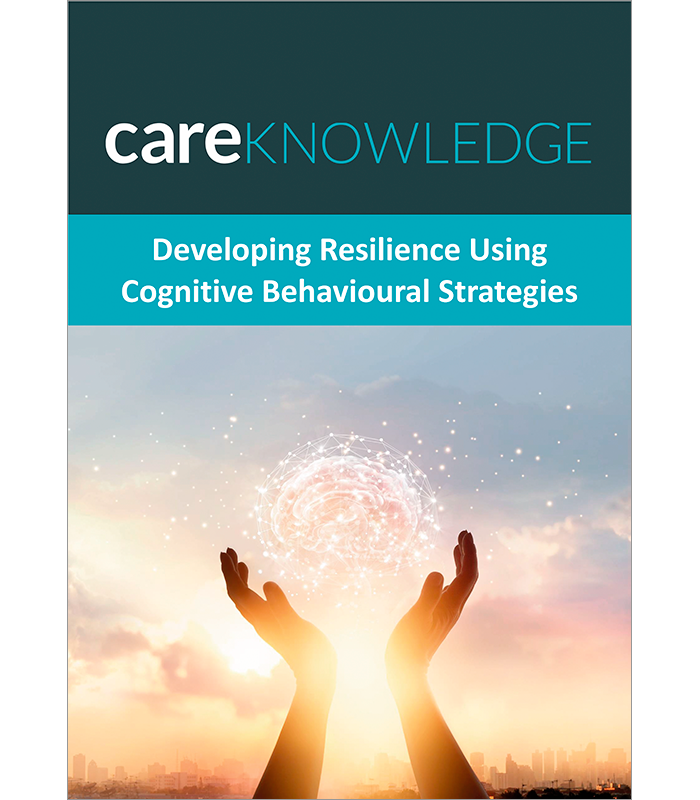
Developing Resilience Using Cognitive Behavioural Strategies

Developing Resilience using Cognitive Behavioural Strategies

Developing Resilience: A CareKnowledge report, written by Dr Kelly J Alexander and Sara Henley, highlights the use of cognitive behavioural therapy (CBT), providing an overview of CBT and its evidence base, focusing on developing skills in using the approach with case examples, and offering guidance about using CBT in practice. It includes a worksheet template for the application of CBT to practice.

“The key principles of CBT can support social care workers to better understand their thinking styles and associated feelings and behaviours; thereby gaining insight in terms of unhelpful responses, identifying more effective coping strategies and enhancing resilience for wellbeing and practice.”

This report was first published on CareKnowledge, the subscription service supporting essential workforce development for adult and children’s social care. Find out how CareKnowledge can support your practice and continuing professional development here.

CareKnowledge

CareKnowledge Question mark Subscription Image

A single-user CareKnowledge subscription supports your professional development in adult and children’s social care with:

  • Unlimited access to evidence-based information across the whole spectrum of social work practice
  • Different types of content to suit every need and topic: opinion pieces, briefings, special reports, legal articles and research
  • Twice-weekly email updates bringing you the latest developments and analysis
  • MyCPD digital continuing professional development tracker
  • Access to The Bookshelf containing a selection of key social care publications from Pavilion Publishing and others

New! Exclusive access to webinar replays

While our CareKnowledge Live webinars are open to all, members receive exclusive access to video and audio replays.

Digital access: After receiving your order, our Customer Services team will set up your online access and contact you with your CareKnowledge login details within one working day.

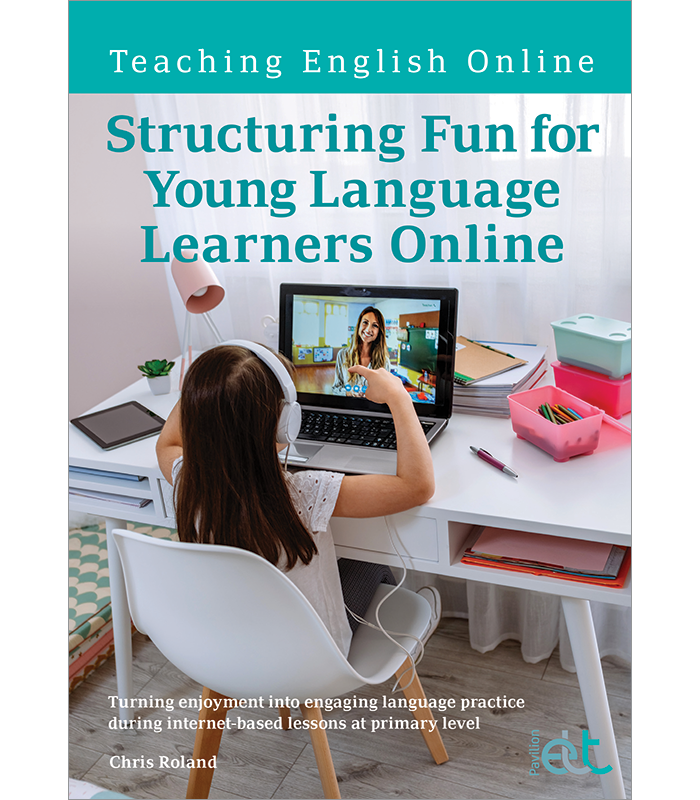
Structuring Fun for Young Language Learners Online

Cover for the book: Structuring Fun for Young Learners Online

The Teaching English series offers a mixture of methodology and practical ideas for teachers of English as a foreign language. Structuring Fun for Young Language Learners Online aims to provide ELT teachers, directors of studies and academic managers with advice about making the transition to teaching online. Offering a mixture of methodology and practical ideas to get teachers started on an online platform, and to support them in creating and delivering dynamic and creative lessons whether they are teaching solely online or in combination with physical classes.

Structuring Fun for Young Language Learners Online aims to provide ELT teachers, directors of studies and academic managers with advice about making the transition to teaching online, including: examples related to the author’s own experience, online safety and best practice; managing your online classroom, dealing with stress and supporting learners; adapting traditional tasks and making the most of the online medium. The book includes a wide range of colourful activities and numerous illustrations and examples from actual online classes. Throughout, the goal is to help make lessons enjoyable for both teacher and learners. The emphasis is on low-tech, low-prep lessons with maximum results, whilst keeping the focus clearly centred upon the goal of increasing children’s familiarity with and ability to produce words and sentences in English.

In Structuring Fun for Young Language Learners Online the author examines how many principles of best practice (as covered in the recently-published Structuring Fun for Young Learners in the ELT Classroom, Chris Roland, Pavilion Publishing, 2020) from face-to-face lessons translate to online teaching. The author highlights what teachers will need to approach a little differently, and looks at where the new medium allows us to do things that we could not do so easily before.

In a similar way to the other titles in the Teaching English and Teaching English Online series, this book can be used for self-study, as guided reading on more structured training courses – where the three boxes for reflection and discussion at the end of each chapter (Questions for Reflection, Things to Try and Things to Share) can be used as the basis for group discussion – or for trainers preparing their own sessions at an in-house level.

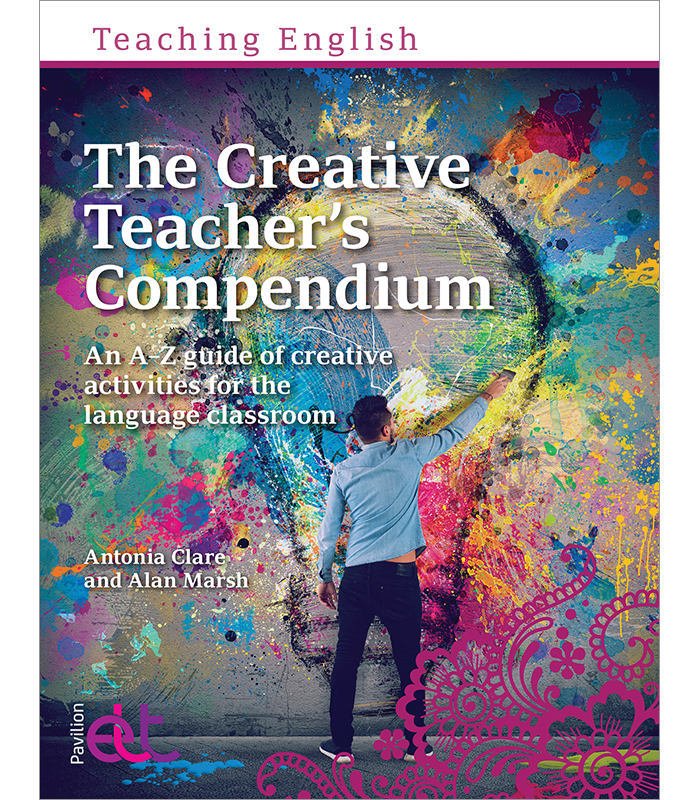
The Creative Teacher’s Compendium

Cover of the book - The Creative Teacher's Compendium

The Creative Teacher’s Compendium offers teachers an exciting and varied collection of creative ideas and techniques for the classroom. You will find low-preparation, practical ideas in an easily-referenced A-Z format.

Creativity is a hugely exciting concept in teaching today — and vital for both teachers and learners. This book therefore aims to empower you to experiment in your day-to-day practice. It will help you develop your own repertoire of creative ideas, and help you grow as an ELT professional. For your learners, this means richer lessons, increased motivation, and the confidence to rise to learning challenges.

The Creative Teacher’s Compendium contains an alphabetical list of chapters with topics related to creative language teaching. These topics include Art, Beginnings, Conversations, Dictation, Emotions, Film — and so on.  Each chapter begins with a relevant quote for the topic, then a short discussion of why this area is important for creative language teaching.  This discussion provides a clear rationale and directs teachers to relevant research in the area.  Each chapter then includes a series of creative activities, which can be used as they are or easily adapted to suit teachers’ and learners’ needs.  The creative activities are always clearly linked to suggested language points, and sample materials show how these can be exploited.  The chapters end with ideas for reflective teacher development and tasks which can be used for workshops.

Whatever context you teach in, The Creative Teacher’s Compendium will equip you with the tools, inspiration and encouragement to explore the increasingly vital role of creativity in the 21st century classroom.

Reviews:

“The book is user friendly as the authors indicate the timing and the level; the procedure is straightforward to follow. This is a very hands-on dip-in resource book; the authors spare you long introductions about creativity. Just 18 pages! Instead there is a feast of creativity for you to enjoy.” – Hanna Kryszewska, Humanising Language Teaching, February 2021

“When I first opened this book, I realised it is the type of activity book that I treasure, one with a wide range of activities that could be used in a variety of teaching contexts… This book is wholly recommendable, and it deserves to be on the shelf of every language teacher.” – This review by Hall Houston was featured in the IATEFL Voices publication (Issue 282, 2021). Find out more about becoming a member of IATEFL here.

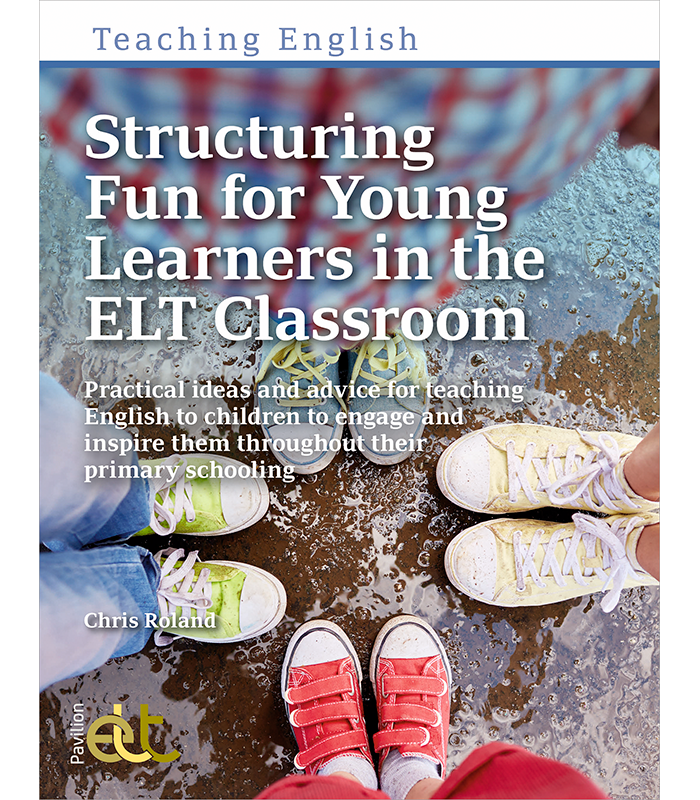
Structuring Fun for Young Learners in the ELT Classroom

Structuring Fun for Young Learners in the ELT Classroom

Structuring Fun for Young Learners in the ELT Classroom is designed for ELT teachers, directors of studies and academic managers.  It provides an extensive repertoire of creative ideas and techniques to work with in the classroom.

Teaching young learners can be a huge amount of fun. As teachers, we can introduce all sorts of games, projects and variations on traditional exercises. All this needs careful structuring if the resulting activity is to be manageable and, more importantly, if it is going to help students learn and practise words and sentences in English. In Structuring Fun for Young Learners you’ll learn about the principles behind that structure. Chris Roland provides a roller coaster ride of colourful ideas, examples and anecdotes for your classroom. In addition, there are over three hundred diagrams and photographs to help explain exactly how the described activities work and give you the flavor of ELT classes at primary level.

When fun in the classroom is properly structured, everyone is a winner. Your students will remember those activities for years and you will still be able to cover your course content without compromising on classroom management. For this to happen, we have to ask important questions such as: ‘How do children behave in classrooms?’, ‘Why do they want to do some tasks and refuse to do others?’, ‘What is learning anyway and how can we tie our target words and sentences to the activities we do?’. These fundamentals are covered in the first five chapters of the book.

The second part of the book explores movement, text, space, novelty objects, teacher-student dialogue, personalisation, clips, images, support for learners, and the use of coursebooks. In addition, it examines your own professional development as a young learner teacher. So, whether you are a new teacher, a seasoned veteran or a teacher trainer with young learners classes, Structuring Fun for Young Learners in the ELT Classroom is for you.

The Teaching English series offers a mixture of methodology and practical ideas for teachers of English as a foreign language. Like Understanding Teenagers in the ELT Classroom by Chris Roland, this book can be used:

  • for self-study,
  • as guided reading on more structured training courses,
  • by trainers preparing their own sessions at an in-house level.

If you currently teach online, take a look at Chris’ accompanying title: Structuring Fun for Young Language Learners Online

Reviews:

“The book is imaginative, humorous and often inspirational; it is liberally illustrated with photographs. The author’s style is highly personable. Should prove useful for new and experienced teachers of children.” – Pete Sharma, EL Gazette. Read the full review here.

Structuring Fun for Young Learners in the ELT Classroom can contribute to the innovative tools and inspiration primary English language teachers are looking for. [It] is more than just a recipe book of activities and ideas; it also provides support for those activities, addressing the reasons why and the ways in which activities work through real examples and personal anecdotes… For primary English language teachers looking to refresh, ignite or inspire new ideas in their classrooms, this book is a good resource.” – This review by Heidi Haavan Grosch was featured in the IATEFL YLTSIG TEYLT Worldwide publication (Issue 1, 2021). Find out more about becoming a member of IATEFL YLTSIG here.

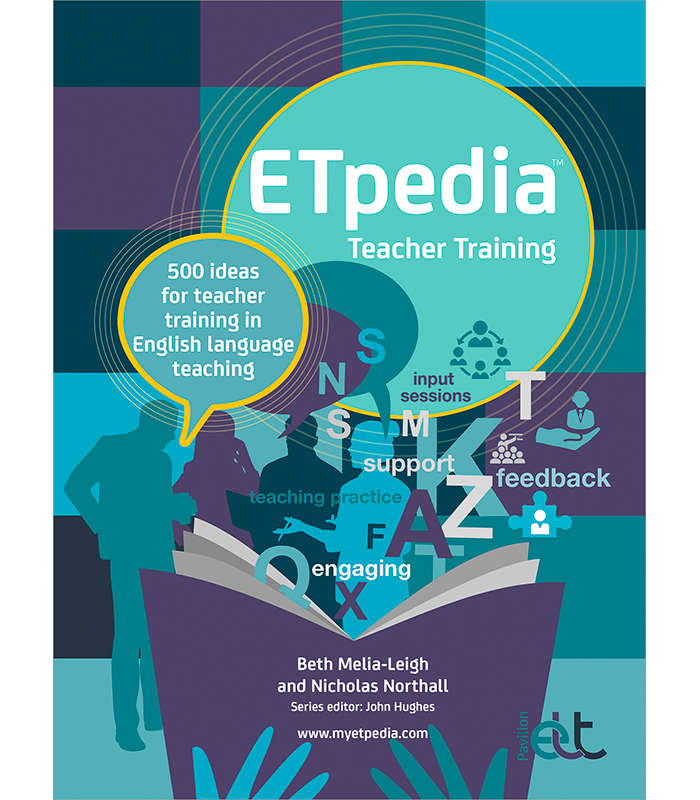
ETpedia Teacher Training

Cover of the book - ETpedia Teacher Training

ETpedia Teacher Training provides both new and more experienced teacher trainers with pointers, ideas and activities to support both pre- and in-service teachers. In addition, you can use it in a variety of different teaching contexts, including in the classroom and online. Each unit of 10 tips is easy to use and will aid or inspire you whether you are dipping in for a quick idea or looking for more comprehensive guidance.

Here are 10 reasons to use it as part of your teacher training practice:

  1. Learn more about the different aspects of a teacher trainer’s role
  2. Get support with making the transition from teacher to trainer
  3. Make your training more engaging
  4. Get inspiration for preparing input sessions
  5. Recap techniques and activities you haven’t used in a while
  6. Supplement your repertoire with fresh new ideas
  7. Develop your mentoring skills
  8. Use alternative approaches to observation
  9. Fine-tune your feedback skills
  10. Integrate online training techniques.

Whether you’re a new teacher trainer looking for support, or a more experienced teacher trainer, this is the book for you. ETpedia Teaching Training is packed with ideas for beginning TT courses, input sessions, teaching practice, lesson planning, lesson observations, self-reflection, giving feedback, assignments and written tasks, different training contexts, further development and ending TT courses.

You can view a sample chapter from ETpedia Teacher Training here.

ETpedia Teacher Training is part of the ETpedia series. Each title offers practical tips and ideas across a wide range of topics. You can explore the full range here.

Reviews:

“I don’t often fall in love with books at first glance, but I have to admit I was pretty close to it when I opened my kindle version. For a new CELTA tutor or teacher trainer in a different context, this book will be a ‘go-to’ resource for many years to come.” – Sandee Thompson, Modern English Teacher, April 2021.

“Transferability, thy name is ETpedia! This book has accessible and immediately applicable resources, ‘top tips’ and ideas for using in a wide range of contexts, and is a refreshingly easy yet informative and practical read. The fully photocopiable resources are well selected, professional looking, and deal with a wide range of areas”. Rufus James, English Australia Journal, 2020. You can read the full detailed review here.

“Given the current, emergency shift to online teaching, I was delighted to read Unit 43 on online and blended teacher training, and further tips on using online forums. There is useful input on mentoring, dealing with difficult trainees and self-reflection; the Appendix is extensive. This highly-practical book will certainly be welcomed by teacher trainers.” – Pete Sharma, EL Gazette, July 2020. You can read the full book of the month review here.

ETpedia Management

Cover of the book - ETpedia Management - 500 ideas for managing an English Language school

ETpedia Management brings you 500 tips, ideas, and concepts to help you run an English language school. Over 50 list-based units, it covers everything from the basic principles of running a language school, department or organisation, to problem solving and growth management. You’ll find inspiration in each unit whether you’re managing for the first time or an experienced manager looking to further develop your skill set.

Many of the units also contain an activity based on a photocopiable handout, which you will find in the Appendix. These are motivating tasks, perfect for self-reflection or for your teachers to do in a continuing professional development session. They’re also adaptable – you can use them as they are or develop them to suit your own context.

Throughout the book you will find quotes from experienced managers, Director of Studies. Here you’ll find school owners sharing their views, ideas and experiences on managing an English Language school or department.

ETpedia Management is the tenth title in the popular ETpedia series.


Reviews

“A practical resource for ELT managers to help with those adjustments necessitated by making the change from teacher to manager. New and experienced ELT managers can benefit from this collection of pragmatic and ELT-specific resources all available in one place. ETpedia Management provides a wealth of ideas and materials that allow for self-reflection, collaboration and real-life application to a language school context.” – Jakki Postlethwaite, English Australia Journal, 2020. You can read the full detailed review here

This will be a valuable resource for people at any stage of their career with an interest in ELT management. It provides useful advice for those embarking on management, studying for a qualification in ELT management, preparing for an interview or training for a new management position. It also contains resources to inspire experienced managers looking for fresh ideas.” – Peter Beech, IATEFL Voices (274)

Language teachers moving into management positions often find themselves learning ‘on the job’. This 200-page, spiral-bound reference guide will be especially useful for them, providing advice in several key areas including marketing, personnel, finance and continuous professional development (CPD)… Draws on the expert experience of the author team.” – Pete Sharma, EL Gazette (470), May 2020. 

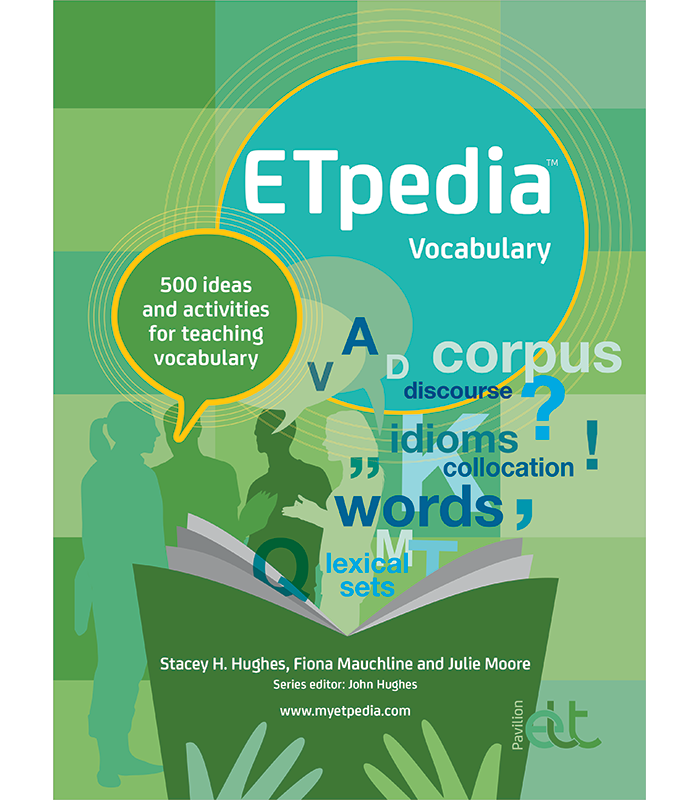
ETpedia Vocabulary

Cover of the book - ETpedia Vocabulary - 500 ideas and activities for teaching vocabulary

ETpedia Vocabulary is a one-stop resource for newly qualified English language teachers and teachers who want to learn new ways for teaching vocabulary. It is also perfect for teachers who need to adapt to teaching in a new context. Suitable for use in different ways according to your needs, interests and level of experience, it’s equally useful for new and experienced teachers.

Organised into 50 units each containing 10 ideas, ETpedia Vocabulary is easy to dip in and out of. It will save you planning time, provide inspiration, and help you motivate students. It will even anticipate problems students might have with different aspects of vocabulary.

Inside, you’ll find sections focusing on different areas such as:

  • key terms for talking about vocabulary
  • ideas for planning vocabulary lessons
  • ways of integrating vocabulary into your skills-based lessons
  • tips on integrating technology in order to extend vocabulary practice and awareness.

Each unit provides you with 10 tips, ideas or activities related to theory and practice in the classroom as well as suggestions for homework and self-study tasks. In the Appendix you will also find photocopiable handouts with additional classroom activities. These can be used exactly as they are, or adapted and developed to suit your own context. Throughout the book you will also find quotes from experienced teachers, sharing their views, ideas and experiences on teaching vocabulary.

If you are new to teaching, ETpedia Vocabulary will support you on your way. If you’re an experienced teacher, it will remind you of techniques and activities you haven’t used in a while and offer you fresh new ideas to increase your repertoire. You can view a sample chapter here.

ETpedia Vocabulary is the ninth title in the popular ETpedia series.


Reviews:

“This A4 spiral-bound book should appeal to new and experienced teachers alike. You can dip in for bite-sized activities or work through more systematically. The authors’ wide-ranging experience shines through.”EL Gazette, January 2020.