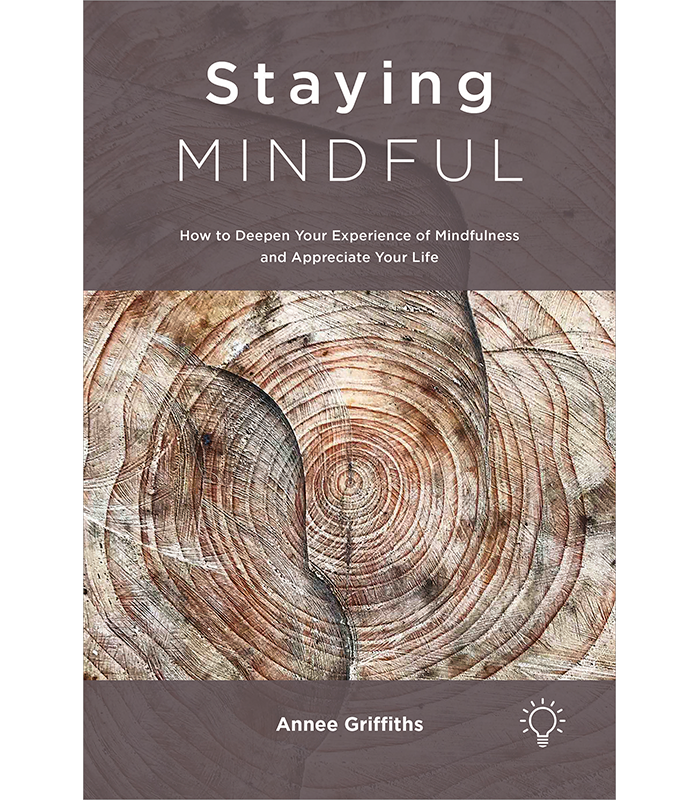
Staying Mindful

Staying Mindful

Sustaining a mindfulness meditation practice is challenging. Many people complete an eight-week introductory MBSR or MBCT course with the best of intentions, only to quickly let things slip as competing pressures take over and the time to stop and pause dries up. Addressing this issue, Staying Mindful refreshes and deepens the learning gained in typical introductory mindfulness courses, and provides a wealth of guidance to encourage and inspire ongoing practice.

Based on a six-week training course developed and run for many years by the author, it is perfect for anyone who has taken an MBSR or MBCT course and wishes to restart or reinvigorate their mindfulness practice. It is also the ideal textbook for advanced courses. It fills a clear gap in the market as most titles in this area are introductory – no authoritative ‘next step’ books exist to guide individuals in further developing their mindfulness skills.

Whose Tune Are We Dancing To Anyway?

Whose Tune are We Dancing to Anyway

Explore ‘Whose Tune Are We Dancing To Anyway?’ to understand how Non-violent Resistance (NVR) empowers parent participation and transforms family dynamics in challenging environments.

Parent participation in Non-violent Resistance (NVR) is an approach developed by author Elisabeth Heismann and colleagues that uses principles of NVR to help carers resist violent and out of control behaviours and to establish a warm, loving and containing parental presence with their children.  It is based on 15 years of collaborative practice in various settings and organisations and is presented as a formula for good practice.

In this unique book, three parents with lived experience of using NVR and a family therapist who has used the approach extensively, demonstrate the experience and positive impact of parent participation in NVR in one of London’s most polarised boroughs in terms of the distribution of wealth and deprivation, where gang problems, knife crime and child sexual exploitation are rife. The challenges they have faced represent issues many families experience in the UK and beyond, where young people, families and communities can feel judged and pathologised as ‘bad’ and consequently do not voluntarily access existing social care, mental health and educational services, or want to ‘dance to their tune’.

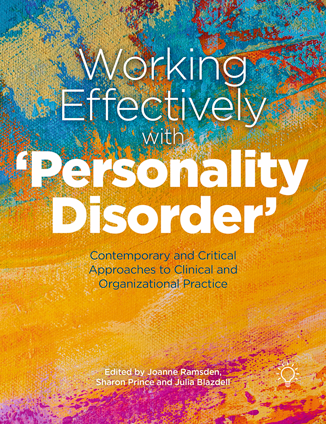
Working Effectively with ‘Personality Disorder’

Cover of the book - Working Effectively with Personality Disorder

Working Effectively with ‘Personality Disorder’ shares this knowledge, articulating an alternative way of working that acknowledges the contemporary debate around diagnosis, reveals flawed assumptions underlying current approaches, and argues for services that work more positively, more holistically and with a wider, more socially focused agenda.

The history of ‘personality disorder’ services is problematic to say the least. The very concept is under fire, services are often expensive and ineffective, and many service users report feeling that they have been deceived, stigmatised and excluded. Yet while there are, inevitably, serious (and often destructive) relational challenges involved in the work, creative networks of learning do exist – professionals who are striving to provide progressive, compassionate services for and with this client group.

Schema Therapy for Children and Adolescents

Cover of the book - Schema Therapy for Children and Adolescents

Schema Therapy for Children and Adolescents – A Practitioner’s Guide

Schema therapy, built on the fulfilment of basic human needs across key stages of the life span, has attracted high interest among practitioners and commissioners for its high success rates over relatively brief courses of treatment. This book presents the first guide to adapting schema therapy for children and young people. It describes a wide range of innovative child- and parent-specific techniques, with detailed information on how to apply them across five key stages from infancy to the age of 23.

Guidance is provided on how to enact age-appropriate schema dialogues, using play to reinforce or replace imagery rescripting, and case studies bring the material to life. The book also breaks new ground in moving beyond the core relationship to ‘schema coaching’ – the education and support of key carers in recognising an individual child’s needs and the maladaptive patterns that may be caused or exacerbated by their own schemas.