Discover how ‘Listening with All Our Senses‘ reshapes support for those with autism & profound disabilities through innovative, empathetic communication techniques. The three texts brought together in Listening with All Our Senses offer a new perspective for those supporting people with autism and/or profound and multiple learning disabilities.
Phoebe Caldwell emphasises the importance of shifting the focus away from the label of ‘challenging behaviour’ and instead offers practical advice for ways that we can help to alleviate the distress that may be at the root of such behaviours, by communicating with people on their own terms and in their own ‘language’. She uses multiple case studies from her years of experience in the field to illustrate Intensive Interaction and the innovative techniques that she has developed for entering the person’s world, as they experience it, and approaching two-way communication from this perspective.
The compendium includes a new introduction written by Phoebe Caldwell, and You Don’t Know What It’s Like also features an updated ‘GP’s viewpoint’ provided by Dr Matt Hoghton.
Enhance your understanding of empowering ‘Creative Conversations’ with individuals with profound disabilities via expert-guided techniques. Intensive Interaction is probably the most positive and accessible way of getting in touch with and empowering people who may seem locked in their ‘inner world’. This DVD training resource seeks to bridge the gap in the range of currently available material on the use of Intensive Interaction and shows how Intensive Interaction is used to find ways of communicating with people who have multiple and profound learning disabilities, enabling them to express their feelings as well as their needs.
It shows care staff and family carers learning to use a number of simple Intensive Interaction techniques with four adults, under the guidance of Phoebe Caldwell. It also includes explanatory discussion between Phoebe Caldwell and Pene Stevens, a clinical nurse specialist in the field, and from the carers themselves supplement these powerful films.
Discover essential strategies for communicating effectively with people with learning disabilities to promote independence, rights, and inclusion. People with learning disabilities often depend on others for the support they need in order to live their lives. For this reason, effective communication is essential if people with learning disabilities are to secure rights, inclusion, choice and independence. The degree to which individuals depend on the support of others varies from one person to the next – support may be for just a couple of hours a week to do the shopping and make sure the bills get paid, or, for an individual with high support needs, it may be round-the-clock help from a small team of personal assistants. For all individuals, however, the effectiveness of the support provided depends on the quality of the relationship between the individual and those who support them. The quality of this relationship depends, in turn, on the quality of the communication between them.
This Care Quality Guide is based on the training pack Effective Communication with People with Learning Disabilities, and explains the fundamental basics of good communication to inspire care workers to think about the way they communicate with the people in their care.
Communicating Effectively with Individuals with Learning Disabilities: A Care Quality Guide for health and social care staff and carers distils the information in the main training pack and includes new and unique content to allow for individual study.
It explores the EPIC model of communication, devised by the authors, and how the four elements of this model need to be in place for good communication to take place:
E – The communication Environment
P – The communication Partner
I – The Individual’s communication skills
C – The communication Culture
In this model, the communication partner is the essential element of the jigsaw that needs to be in place for all the others to connect.
It also covers how to avoid communication breaking down, and practical guidance for techniques to repair if and when it does, and provides descriptions of a wide range of communication techniques and aids to further enhance work with people with learning disabilities, such as gesture and eye gaze, pictures and photographs, visual timetables and hi-tech communication aids using, for example, or other technological supports.
A decade after Learning Disability Today was first published, this (3rd Edition) reviews the progress made with this mission. Individuals with learning disabilities and their families find themselves in a changing world where they are being offered more personalised services and support, within a challenging climate of economic downturn. The focus on person-centred services and quality of life has become increasingly important as the development of support in the community continues to strive for inclusion for all, including people with the most complex needs.
Learning Disability Today (3rd Edition) revises previous chapters and includes brand new ones that examine current issues being grappled with by those using and delivering services and support. The book takes an optimistic stance, striving to renew and extend the enthusiasm of the first edition in the face of an ever-changing landscape of policy and provision. Many of the chapter themes reflect the learning outcomes of units within the QCF learning disability qualifications introduced in 2011. These include: person-centred thinking, assessing and managing risk, active support, self-directed support, accessing healthcare, sexuality, supporting individuals with autistic spectrum conditions and supporting parents with learning disabilities. The content will be helpful for support staff, personal assistants and others who are working towards a learning disability Award, Certificate or Pathway of the Health and Social Care Diploma at level 2 or 3 within the QCF framework. The book will also make a valuable contribution towards the Continuing Professional Development of a wide range of qualified staff who work with, or come into contact with, people who have learning disabilities.
As with previous editions, Learning Disability Today (3rd Edition) is set out in three main sections. Setting the scene provides historical background as well as a discussion of the values, ideology and legislation underpinning current learning disability provision. Being more aware of our own position in society and what we personally bring to the service setting is essential to good practice, and such awareness is likely to enhance the collaboration between supporters and those being supported. This understanding of context is linked to an understanding of our role and accompanying responsibilities within vital areas such as adult protection. Similarly, acknowledgement of the issues relating to the vulnerability of people with learning disabilities within risk management helps to ensure that we support autonomy and individual expression, and avoid the development of oppressive practices. This section is grounded in a detailed discussion of person-centred thinking, the essence of which weaves its way throughout the remaining chapters of the book.
The second section of Learning Disability Today (3rd Edition) looks at ways of developing people. The chapters here set out pointers for good practice, enabling readers to apply some of the important ideas and principles set out in the first section. A new chapter on active support is included as part of this section, along with a chapter on self-directed support, the development of which has transformed the ways that those both using and working in services consider the role of power and responsibility.
The final section looks at the ways in which together, people with learning disabilities and their supporters are shaping lives. The chapters here discuss some of the challenges and aspirations that people face, and look at how people with learning disabilities can be supported to make their own choices and ultimately have the freedom and support to live their lives. The emphasis throughout is on developing inclusive practices, built upon the values and principles established in earlier chapters of the book.
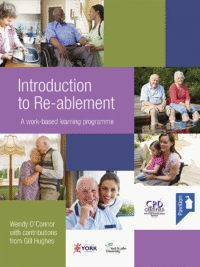
Introduction to Re-ablement introduces health and social care staff to the re-ablement approach and empowers them to embrace the culture within their own practice.
All staff working in social care should be aware of the re-ablement approach and embrace the change of culture within their practice. Re-ablement should not be viewed as a short-term service, but rather as a person-centred, outcomes-focused approach to support planning; one that promotes the independence, participation, choice and control of each individual.
Underpinning the Introduction to Re-ablement work-based learning programme is an emphasis on the concepts of independence, empowerment and personalisation. The training is delivered through four thought-provoking and interactive sessions, which cover:
the key concepts of re-ablement
models of disability and barriers to activities of daily living (ADL)
re-ablement techniques, equipment and assistive technology
goal setting and re-ablement planning in practice.
After completing the training course staff should be able to:
explain the principles of the re-ablement approach
work within multi-agency, re-ablement-focused teams to promote independence
contribute to outcomes-focused goal setting for customers
understand the contribution that adaptive equipment and rehabilitation techniques can make to the re-ablement approach.
The pack contains all of the resources that the facilitator will need to deliver the training, including PowerPoint slides, handouts and instructions for practical activities that will help learners to enhance their understanding by experiencing barriers to ADL for themselves.
The pack also includes a Microsoft Word learner workbook to complement the taught sessions. By reading through the workbook and completing thinking exercises in preparation for each session, learners can not only evidence their learning but also explore ways to put what they have learned into practice.
Improve your ability to assist individuals with mental health challenges with our self-study friendly program, ideal for team growth – Developed by Signpost UK. The Independent Mental Health Broker Training pack gives participants the skills they need to work as support brokers for people with mental health problems.
The course runs for five days and is broken down into five modules with step-by-step instructions for running the training. The accompanying CD-ROM contains all the materials and PowerPoint slides needed for the course.
The materials are designed for self-study and learning within teams of support workers, and training groups and people in-house by skilled and experienced practitioners.
The course runs for five days and is broken down into five modules with step-by-step instructions for running the training. The accompanying CD-ROM contains all the materials and PowerPoint slides needed for the course.
The materials are designed for self-study and learning within teams of support workers, and training groups and people in-house by skilled and experienced practitioners.
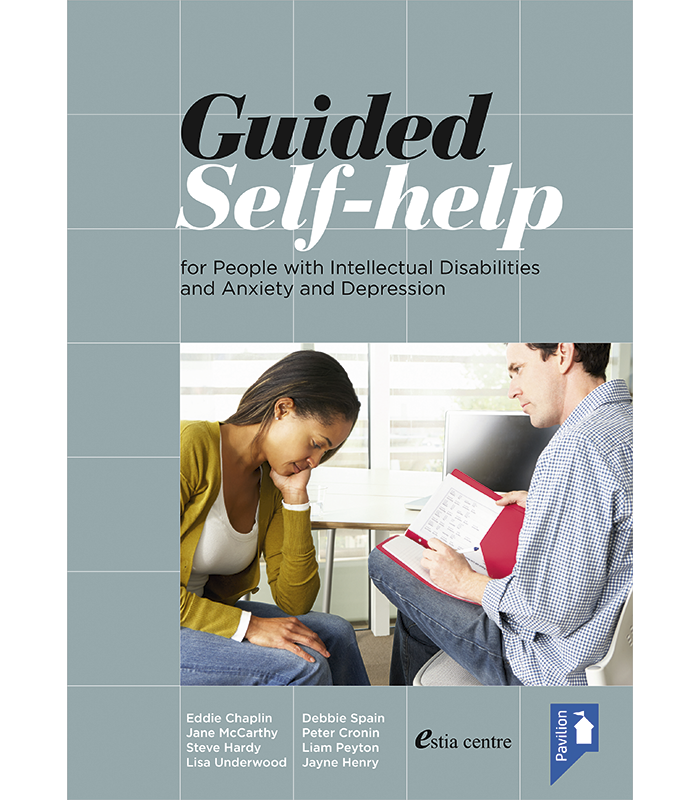
The use of guided self-help for people with intellectual disabilities to treat depression and/or anxiety is in its infancy. The SAINT (Self-Assessment and INTervention) is the first resource to be made commonly available which has been developed specifically for people with intellectual disabilities.
Using colour photographs and easy read text, the SAINT offers a structured and accessible way to deliver guided self-help with this population. By using a daily diary, clients can learn to recognise their emotions and develop ways to cope with them.
This facilitator manual explores the role of guided self help, its evidence base and its role in treating anxiety and depression. It details the development of the SAINT and the rationale for its use, and offers experiences from individuals who have used it in their own lives. The manual will help a facilitator to prepare for sessions with a client who is using the SAINT.
This revised third edition of Caring for the Older Person has been refreshed to comply with the Skills for Care Common Induction Standards for newly appointed care workers. It also takes into account the guidelines being developed by the Care Quality Commission and the Qualifications and Credit framework.
This easy to use learner workbook enables the newly appointed care worker and their manager/employer to ensure their training meets the Skills for Care Common Induction Standards, and that they have the necessary skills and knowledge to work safely and appropriately with older people.
This refreshed learner workbook includes activities, learning logs, quizzes and end of chapter induction records designed so that the care worker can keep evidence of the completed activities in their professional development portfolio.
Female genital mutilation (FGM) is a healthcare and safeguarding issue that is currently high up on the government’s agenda and a major priority for NHS England.
With concerning gaps in knowledge in the field of female genital mutilation among healthcare professionals, this handbook aims to address these including diagnosis, implications and management of FGM cases, particularly in relation to national guidance, legal aspects, safeguarding issues and resources, including support groups.
Professionals within the social care sector are required to undertake Continuous Professional Development (CPD) by the Health and Care Professions Council (HCPC). Those who use this resource will be able to gain CPD points.
Free UK Postage on all orders over £20 in UK - sign up to our newsletter for 10% off your first order. Dismiss
We use cookies on our website. One group is essential for our business and another provides third party services. Click OK to accept all cookies, Opt-out to refuse services cookies, or visit our Cookie Policy.