Working with Emergent Language

Working with Emergent Language Cover

Emergent language (EL) is any unplanned language item that arises naturally during lessons that the teacher then chooses to focus on for clarification or modification, and this pedagogy is gaining traction year on year. It originally stemmed from Dogme, a popular movement that basically suggested not using coursebooks or set texts in class at all and working with what the students and the teacher themselves provide. Emergent language takes on board lessons learnt from using Dogme and current teaching practices. However, working with EL is considered a very difficult skill to master, especially for newer teachers or trainee teachers. Therefore, it is not often included on training courses or discussed at length in training manuals for teachers. Working with Emergent Language seeks to close this gap by making teachers more aware of what EL is and how they can learn to work with it more effectively and confidently.

What does Working with Emergent Language cover?

This book starts by drawing on the literature and the authors’ own experiences to make the case that working with EL is essential for language acquisition to occur and therefore a skill that language teachers should possess. The case is backed up by research and data from observations to explore how experienced teachers work with EL at different stages of a lesson and why they do so. To show how teachers work with EL, you will be introduced to a new framework of teacher intervention types. This draws on previous frameworks plus the authors’ own terms created following their extensive research. Transcripts and classroom commentaries from genuine lessons show how these interventions are used by teachers and why.

Part two of Working with Emergent Language provides awareness-raising, practice, and reflective tasks to help new and experienced teachers develop their skills with EL. Teacher trainers and educators can also use these tasks during courses, workshops, and observations programmes in schools. Through these tasks, new teachers will be able to work with EL earlier in their careers. Teacher educators can also more confidently introduce EL on their courses. Through the tasks and discussion in this section, you will learn why reflective practice is central to teacher education and development, and through the use of tasks explained in the book, teachers can also take control of their development much earlier in their careers.

The final part of the book addresses typical questions and issues about working with emergent language that teachers often ask. They dispel common conceptions suggesting that working with EL is difficult or inappropriate in some contexts and situations.

These questions include:
  • ‘Can you work with EL with lower levels/teens/younger learners?’,
  • ‘Is it difficult for teachers whose 1st language is not English to work with EL?’,
  • ‘Can you work with EL in exam classes or when you are following a syllabus?’,
  • ‘How can you work with EL when teaching online?’,
  • ‘How might the 1st language be used when working with EL?’.

Working with Emergent Language is part of the Teaching English series, which offers practical methodology across a wide range of different topics. Danny Norrington-Davies is also the author of Teaching Grammar: From Rules to Reasonsby Pavilion ELT.

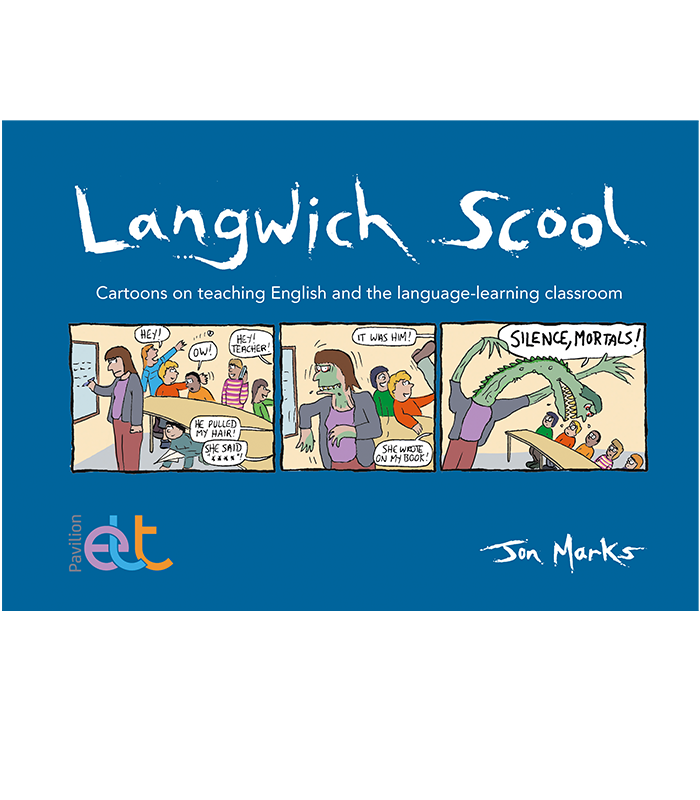
Langwich Scool

Book Cover Image: Langwich Scool: Cartoons on teaching English and the language-learning classroom

Welcome to Langwich Scool!

Whether you fondly remember Langwich School from ETp or it is totally new to you, if you are looking for a wry, humorous commentary on the state of English language teaching, the challenges teachers face and typical learning environments then this is the book for you. It is a simple pick up and flick through cartoon book, for you to dip in to. Perfect as a present or as a treat for yourself, we welcome you to Langwich Scool! Take a walk through Langwich Scool, which first opened its doors in 1999, in Issue 13 of English Teaching professional.

You will discover familiar language teaching scenarios, incidents with students, conversations in the staffroom, trials with professional development, and a whole lot more besides… Topics covered also include teaching children, teenagers and adults and some of the challenges each of these pose. With a healthy dose of wry humour, Jon Marks lifts the lid on the goings on through his cartoon strips. You can see them here all in colour for the first time, alongside some new, unseen till now, cartoons designed to bring the school bang up to date and through the time of the pandemic, and to make anyone in the teaching business laugh out loud!

Integrating Authentic Listening into the Language Classroom

Cover of the book - Integrating Authentic Listening into the Language Classroom
Integrating Authentic Listening into the Language Classroom looks at the theory around the need to use authentic listening. It then covers the practical ways teachers can use authentic listening in their classes.

Historically, English language teachers have not been trained in how to effectively teach authentic listening. Consequently, they avoid using authentic recordings with their students. In addition, the scripted and graded recordings used to model new language (lexis and grammar) in coursebooks are very different from the spontaneous spoken English students encounter beyond the ELT classroom. We are currently doing our students a huge disservice in not training them to cope with authentic speech. This is what the author seeks to remedy in Integrating Authentic Listening into the Language Classroom.

Creating a methodology book like this, which leads the field in terms of providing the theory behind listening to spoken English in addition to practical guidance and useful examples, means readers will benefit from learning the theory behind using authentic listening and then understand the need to integrate authentic listening in their classrooms. It will equip readers with the knowledge and skills to use authentic recordings in the classroom. This will enable new and experienced teachers to give excellent foolproof listening lessons using authentic recordings. They can motivate their students, equipping them to cope with listening to spontaneous spoken English beyond the classroom.

The book contains 18 easy-to-digest chapters and aims to be accessible for both new and experienced teachers. It contains tried-and-tested decoding and comprehension activities that work in the ELT classroom. The examples and anecdotes given make the activities relatable to a wide range of teaching contexts. It also contains additional transcripts referred to in the main body of the book, a glossary of key terms, references and an index.

This title is part of the Teaching English series, which offers a mixture of methodology and practical ideas for teachers of English as a foreign language.

Learning While Teaching

Learning While Teaching - Cover Image
Do you know how to teach, but want to improve your proficiency in the language you are teaching? Or do you lack confidence in your linguistic knowledge of that language, and how to explain it to others? If so, Learning While Teaching provides you with the means to improve while you teach.

This practical handbook is designed for language teachers who teach a different language than their first language and want to improve their proficiency in that language. It is also designed for language teachers who teach their first language but lack confidence in their linguistic knowledge and ability to explain it to others. Learning While Teaching offers practical ideas and adaptable activities to help teachers improve their language level autonomously.

Teachers can record the tasks throughout the book to demonstrate their continuous professional development. The tasks should help teachers clearly define their professional strengths and action points. Learning While Teaching is suitable for any in-service language teacher or initial teacher trainee who has a command of English at B1+ level on the Common European Framework of Reference (CEFR). By reading the book, users will inherently find their level and knowledge of English improving.

Contents:

Part 1 explores how language proficiency and linguistic knowledge impact how teachers are perceived by their students, employers, and themselves. Besides helping teachers to enhance their language proficiency and build confidence, it explores ways of tackling different issues that language teachers face on a day-to-day basis (such as employers’ and students’ bias towards first language teachers). It includes anecdotal evidence from teachers coming from different countries and teaching contexts. This aims to help the readers relate to the subject matter and see it from different perspectives. Throughout Part 1, there are reflection tasks for the teachers to complete, and therefore log and track their development. They can then identify where they are in their career and what areas they still want to keep working on.

Part 2 is more practical. It focuses on how teachers can use lesson preparation, delivery, and the teaching community to enhance their language level. Each of the activities comes with a rationale, clear outcomes and a step-by-step guide. This helps explain how it can be integrated into the teaching process and routine, plus adapted for all teaching contexts. The activities will not require significant time to complete, and will gradually enhance the language level in those areas. At the end of each chapter, there is the opportunity to reflect on their learning, conduct experiential learning and evaluate what impact the activities may have on their future teaching practice and development plan.

Learning While Teaching is part of the Teaching English series, which offers a mixture of methodology and practical ideas for teachers of English as a foreign language.

From the author:

“When I just started out teaching, I didn’t feel particularly confident about my own level of English and my ability to explain things to the students or answer their questions. This stopped me from applying for jobs and teaching groups and levels I wanted. I felt that there weren’t many opportunities for me to work on and maintain my language proficiency, and that it was either expensive or time-consuming. So, I started looking for more hands-on and practical ways of doing it, which I could do as a part of my teaching process. These activities became the basis of this book.”

Reviews:

Learning While Teaching broaches that most controversial of topics, native vs non-native speakerism, with a practical no-nonsense handbook aimed to incorporate teacher language development into lesson preparation and activities… As a native speaker who has had the privilege to work with many talented, professional non-native-speaker teachers, I would say that this book does an excellent job in challenging the stigmas that are still prevalent within our industry, whilst offering practical guidance to increase confidence and efficacy in the classroom.” – This review by Charlotte Smith was featured in IATEFL Voices (Issue 286, 2022). Find out more about becoming a member of IATEFL here.

Live Online Teaching

Cover Image: Live Online Teaching
We are in a period where teachers have had to turn to live online teaching, perhaps for the first time. They have had to address many problems, beginning with getting acquainted with the mechanics of using platforms such as Zoom or Microsoft Teams. They have then had to work out how to adapt their teaching to the constraints of the platform.

Live Online Teaching aims to help teachers with live online teaching on platforms such as Zoom, Teams etc. The book offers practical tips to help teachers with the various tools offered by the platforms. This includes features such as shared screens and breakout rooms. In addition, it offers creative activities for teaching online asynchronously. The book addresses the immediate situation that teachers find themselves in post Covid: having to teach classes remotely, and even in hybrid classes. It takes teachers beyond the emergency teaching for the pandemic into the future normal.

The activities are classified in sections according to the tools used to create a communicative situation and involve students. Each section includes some general methodology and technical tips. This is followed by practical activities to show teachers how to implement the recommended practices into their online classroom teaching. In addition, there is a section that focuses on activities for live classes which acknowledges that sitting for a long time in front of a screen is not always optimal for learning. The authors, therefore, have a range of activities under the topic ‘zooming out’. These involve students getting away from the screen by sending them into their local environment to find something and come back and share it.

All the activities contain a short summary at the start which outlines:

  • the aims of the activity,
  • what teaching topic it can be used for,
  • how long it should take,
  • what levels it is for,
  • the preparation needed.

This gives the teacher a good idea of what to prepare and do before embarking on any given activity. Teachers can also locate an activity which practises a specific language point and a section which answers questions they may have about online teaching quickly.

Live Online Teaching is part of the Teaching English series, which offers a mixture of methodology and practical ideas for teachers of English as a foreign language. Lindsay Clandfield is also the co-author of ETpedia Materials Writing with John Hughes.

Understanding Teenage Language Learners Online

Understanding Teenage Language Learners Online - Book Cover

Many teachers are currently teaching teenagers either live online or using hybrid learning. Understanding Teenage Language Learners Online aims to provide ELT teachers, directors of studies and academic managers with advice about making the transition online. It includes practical advice and ideas, methodology, and examples from Chris Roland’s own experience.

The book covers major takeaways for online teaching of teenagers, including:
  • online safety and best practice,
  • managing your online classroom,
  • using the chat box to focus on language,
  • explaining things and getting a response whilst teaching live online,
  • activities and techniques that work well online,
  • using clips, video and other effects,
  • evaluation, feedback and exams.

The book goes much further than simply telling you what to do and how to do it. It also looks at the why. It explains the deeper rationale for decisions we might make as well as exploring the underlying principles and factors that can make or break a lesson. Throughout the book, the goal is to help make lessons motivating and enjoyable for both teacher and learners. The emphasis is on low-tech, low-prep lessons with maximum results.

In Understanding Teenage Language Learners Online the author examines how a large number of principles of best practice from face-to-face lessons (as covered in Understanding Teenagers in the ELT Classroom) translate to online teaching. The two books complement each other for those teaching in class and online, but can also each be used on their own. In this title, Chris Roland discusses what teachers need to do a little differently when teaching online. He also examines how the new medium allows us to do things that we could not do so easily before.

Understanding Teenage Language Learners Online is part of the Teaching English Online series. This series complements the Teaching English series. It offers a mixture of methodology and practical ideas to get teachers started in an online platform, and to support them in creating and delivering dynamic and creative lessons whether they are teaching solely online or doing a combination of online alongside physical classes, i.e. hybrid teaching. In a similar way to the other titles in the Teaching English and Teaching English Online series, this book can be used for self-study, or as guided reading on more structured training courses.

Reviews:

In our current situation, I believe that this is a book every teacher should get their hands on, as it provides insights not only into how to teach teenagers more effectively, but also how to stay safe online and how to cope with the challenges of being in front of the screen for a good portion of the day… The main strength of the book is that it doesn’t overlook the problems that are bound to occur while teaching online: instead, it delves into them and puts forward suggestions and alternative ways of solving them… I can confidently say [it] will definitely help me become a better online teacher. It is a book that I can thoroughly recommend.” – William Chaves Gomes, English Teaching professional (Issue 137, November 2021)

In summary, this is a valuable reference book for anyone passionate about teaching teenagers in an online environment and those who would like to refresh or develop their practice in this area… I congratulate the author for his tremendous work, almost every single line of which resonates with me on one level or another. Whether you are a pedagogical lion or you feel like a fish out of water when it comes to online teaching to groups of teens, this book will guide you in delivering engaging lessons.” – This review by Lyubov Chesnokova was featured in IATEFL YLTSIG’s newsletter TEYLT Worldwide (Issue 1, 2022). Find out more about becoming a member of IATEFL YLTSIG here.

An Introduction to Evidence-Based Teaching in the English Language Classroom

An Introduction to Evidence-based Teaching in the Language Classroom Cover

Do you want to learn more about the evidence, or lack of evidence, supporting common teaching strategies and procedures? An Introduction to Evidence-Based Teaching in English Language Classroom compiles the evidence in one place for you, rather than scattered across a variety of sources: online blogs, conference reports and disparate journal papers.

This practical and accessible resource begins by identifying what ‘evidence-based teaching’ is. It then outlines the key strategies, briefly describing how and why they are supported by evidence. Finally, it moves on to show the practical application of these strategies in ELT with concrete examples and activities.

By using the book, teachers, teacher trainers and educators will:
  • have developed a greater understanding of what evidence-based teaching is and have the tools to evaluate teaching practices;
  • know where to find research to back up evidence-based practice;
  • understand the importance of evidence for how the brain works and how this knowledge helps to combat erroneous beliefs about teaching and learning;
  • have increased their knowledge of the importance of prior knowledge to teaching and learning, and the evidence for this;
  • understand how the memory works as well as cognitive load theory, and the evidence for this;
  • have deepened their understanding of evidence-based teaching strategies and interventions;
  • be able to contrast evidence-based ideas and practices with other teaching interventions not supported by research;
  • have learned how to critically apply evidence-informed ideas and understand ideas and practices that are not supported by evidence;
  • be able to evaluate strategies and interventions in the ELT classroom that have evidence to support or refute them.

It is designed to be a supplement to any initial or in-service teacher education course, plus as a useful resource for teachers at any level who are interested in evidence-based teaching in English Language classes. You should read alongside core teacher training texts, in order to be able to examine common teaching practices.

An Introduction to Evidence-Based Teaching in the English Language Classroom is part of the Teaching English series.

From the author:

“I think this book is quite different to other books on teaching and research (but then again, I would say that). A lot of books about research into teaching are written by researchers attempting to bring research findings to a more general audience. What we have attempted to do is something similar but as all of us are teachers, not researchers, we hope that this will give the work more of a teacher’s perspective on things… While we do mention learning myths and things that don’t have good evidence to support them it isn’t 200 pages of slamming learning styles. There is as much “what works” as “what doesn’t”. The book also features advice for teachers who want to look at research themselves.” – Russell Mayne. Read more insights from Russell in the full blog here.

Reviews:

The blurb refers to this as a practical and accessible resource, which is certainly true… the tone was informative without being patronising and the overviews of research which has been done in various areas were fascinating… I believe it will prove itself as a useful book for the staffroom and on teacher development courses.” – Rachel Connabeer, Modern English Teacher (Vol 30, Issue 4)