



Description
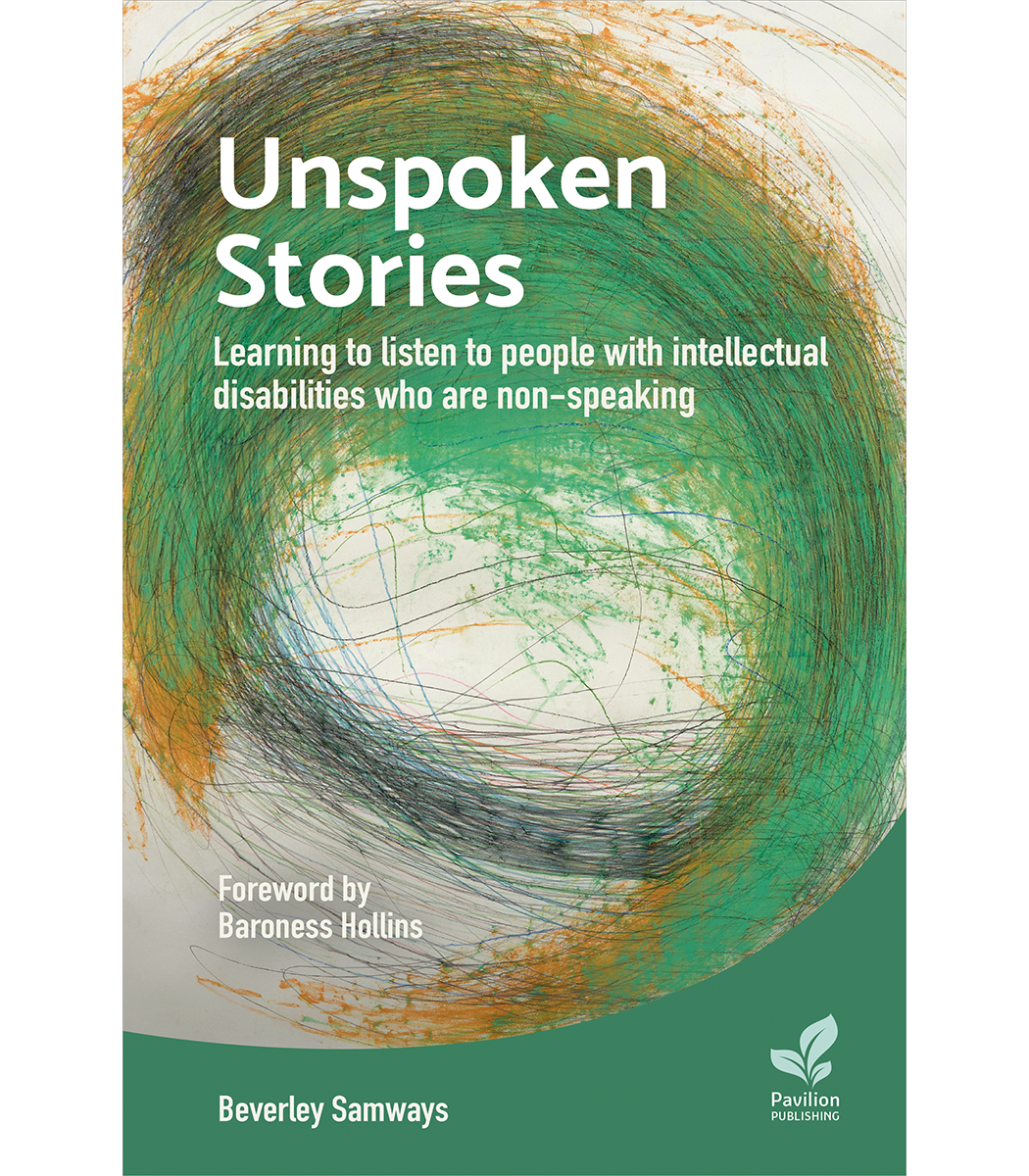
Unspoken Stories reveals the inner worlds of non-speaking young people with intellectual disabilities. Drawing on many months of immersive observation of Cassie and Owen, two young people living in a specialist residential school, author Beverley Samways reveals the emotional depth and intelligence often overlooked in ‘behaviour’, showing that when we truly listen – beyond speech – we can discover rich inner worlds and the profound human need for connection. Eschewing formal academic approaches, she instead uses ethnography and narrative non-fiction to offer a tender, beautifully written journey into Cassie and Owen’s emotional, sensory and relational worlds.
Exploring how feelings can pass between people non-verbally, shaping behaviour and relationships, and how adults must hold and process these emotions carefully for a young person to feel safe, she challenges the systems intended to support these individuals, and reimagines what it means to listen to those who so often go unheard.
About the author
Beverley Samways is the founder and CEO of Unique Connections, a team of specialists who work alongside people with learning disabilities and autism who self-injure or are distressed, as well as the schools and care organisations around them, to create lasting, meaningful change. Unique Connections has a podcast that streams on all platforms. Bev’s career began as a young agency care worker, when a life-changing relationship with a young woman named Shelley shaped her vocation and philosophy of listening. She has since spent more than 25 years in this field.
A practising Christian and deeply relational practitioner, she brings a commitment to justice, connection, and compassionate care. She completed her PhD on the emotional experiences of non-speaking young people who self-injure (including Cassie and Owen from this book), using immersive ethnography to centre voices usually excluded from research.
Content
Foreword by Baroness Sheila Hollins
Introduction
Writing people
Challenging ‘challenging behaviour’
Diagnosis
The research
Introducing Cassie and Owen
The process of participation and consent
Cassie’s Story
Prologue: Who tells the story?
1. Cassie has a secret
2. A drum and a girl
3. Is it okay?
4. Double empathy
5. Missing Jon
6. Cassie is telling this story
7. Mum and Dad in our minds and in our hands
8. We cannot reach her
9. (same day): Here we are
10. Taming the waters that overwhelm us
11. The lightness of her
12. Her capture of me
Owen’s Story
1. This is Owen
2. A door ajar
3. Rest is a person
4. What just happened?
5. A return to proximity
6. Triads
7. Intangibles
8. To speak and be heard
9. Stories told about us
10. Leaving and returning
11. A defence against the cold
12. Being with
Reflections
Unlearning
Behaviour – Yours, mine and everyone else’s
Severe intellectual disabilities
What story are we telling?
When emotions have somewhere to go
Our shared emotional lives
Four frames for understanding our shared emotional lives
Projection
Containment
Transference
Enactments
Holding emotion
Reflective space and story
A place we call home
About families
Learning to listen again
Author:
Beverley Samways

Dr Noelle Blackman, Psychotherapist and previous CEO of Respond –
This is a compelling book, sharing some key findings from Beverley’s unusual and brave PhD research.
Having worked with non-speaking learning disabled adults and children for many years, Beverley has seen first-hand how their emotional lives remain invisible or worse ignored because ‘they are too much’. This is often an unconscious act from carers and professionals, however, the resulting distress caused is the same as if it were deliberate.
Beverley has a strong scepticism about the dominant narrative of behaviour and diagnosis and instead has sought to demonstrate something much more powerful. Through approaching her research from an anthropological perspective, she has immersed herself in her subjects lives and applied ‘deliberate unconditional listening’ in order to try to gain a much rounder sense of Owen and Cassie. She has brought a focus to understanding their inner/emotional lives rather than just attend to their behaviour.
The result is a vulnerable account that often takes your breath away. With both of the research subjects Beverley discovers deep, raw grief that has not previously been understood or fully seen by the day to day staff. The distress felt by both people is overwhelming for them as well as for those around them and is expressed through the way they are in the moment, this is often only seen superficially as ‘their behaviour’. The deeper inner drive causing them to act in the way they do is not understood, especially if the triggers have been set some time earlier.
She describes the ‘busyness’ of the staff, their need to engage people in constant activity, this seems to be a defence against the unnamed pain that is all around but not enabled into consciousness.
There is a remarkable trust built up between Beverley and her subjects over the course of the research, this leads to a real ability for communication on a deep level. There are some wonderful surprises that take place with both Cassie and Owen, these happen because of the time and consistency that Beverley offers them each through her unconditional presence. It is hugely moving and bold. It is not easy to swim against the tide and do things differently within an already established culture. However, the setting should also be praised for being open and curious enough to have facilitated Beverley to conduct this research. We can all learn so much from what this narrative shows us.
I think the power of this book will be in opening people’s eyes to what is right in front of them, hidden in plain sight. If this takes some of the focus away from the behavioural framework, Beverley will have achieved this beautifully.
Dr John M. Keesler, PhD, LMSW –
Through Bev’s writing, we are invited into a profound sense of connection. This book is not merely a clinical observation; it is an act of “life-sharing” that reveals the power of being truly present. Through a lens of timeless curiosity, the unspoken hardships and internal worlds of non-speaking individuals are brought vividly to life, moving the reader to walk with, lean into, and feel the weight of their experiences. Throughout these pages, Bev offers snippets of wisdom that guide us toward new ways of thinking and being. While “trauma-informed care” has become a modern buzzword, Bev’s work embodies its true heart. By understanding the profound life-altering experiences held within the souls of children like Cassie and Owen, she leverages a relational approach to empower those who have been silenced.
She demonstrates that safety and trust are not built through loud gestures, but are quietly established by: holding space for everything an individual carries within; listening and observing beyond the surface level; and engaging in a “skillful dance” led by the individual, supported by a caring other who remains grounded and self-aware. Cassie and Owen’s stories urge us to move beyond the rote responsibilities of daily living and the checklists of support staff. To truly support another, we must become more than caregivers; we become interpreters, translators, and storytellers who bear witness to sorrow, joy, and everything in-between. Perhaps the most poignant takeaway is the necessity of humility. For too long, people with intellectual disabilities have been diminished by paternalism, ableism, and the shadows of institutional care.
Echoing the sentiment of “He must increase, but I must decrease,” Bev’s work challenges us to set aside our pre-judgments. As carers, we must recognize when to take a step back with our own skills and assets to allow the person—the child, the adult, the human being—to increase. By stepping back, we finally allow them the space to tell their own story.
Dr Paddy McNally, Consultant Clinical Psychologist –
We very seldom get the opportunity to challenge our thinking about the internal world of young people who are non-speaking and have high levels of support needs.
This book is beautifully written and sensitively lets us into the internal world of two young people who can become overwhelmed and distressed from their experiences of their world.
I found this book most novel in allowing the reader to go on the journey of relational discovery with the author and the two young people, whilst providing an accessible therapeutic understanding of the process.
I would highly recommend this book to anyone who provides support to a young person who is non-speaking and requires high levels of support.
Rev Dr Kate Coleman, Author, Coach and Founder of Next Leadership –
In the Christian tradition, making unfamiliar or “unknown” languages accessible to whole communities is a time-honoured and deeply incarnational spiritual practice. It is the interpretation of worlds, not merely of words. That sacred work is evident in these pages, shedding light on Cassie and Owen’s stories while reminding us that such work is not beyond any of us.
Bev Samways has ventured where few have chosen to go, making visible what many did not even realise was within reach.
I have long believed that our best leaders are multilingual i.e. able to listen deeply, interpret wisely, and communicate across contexts with clarity and courage. By that measure, and in charting fresh paths and giving voice to what has too often remained unheard, Bev is an extraordinary leader, and Unspoken Stories is a compelling and extraordinary book.
Dr Lucy Series –
Electric. For too long non-speaking people with learning disabilities have been viewed as unable to share their stories, this book shows us that they can.