Description
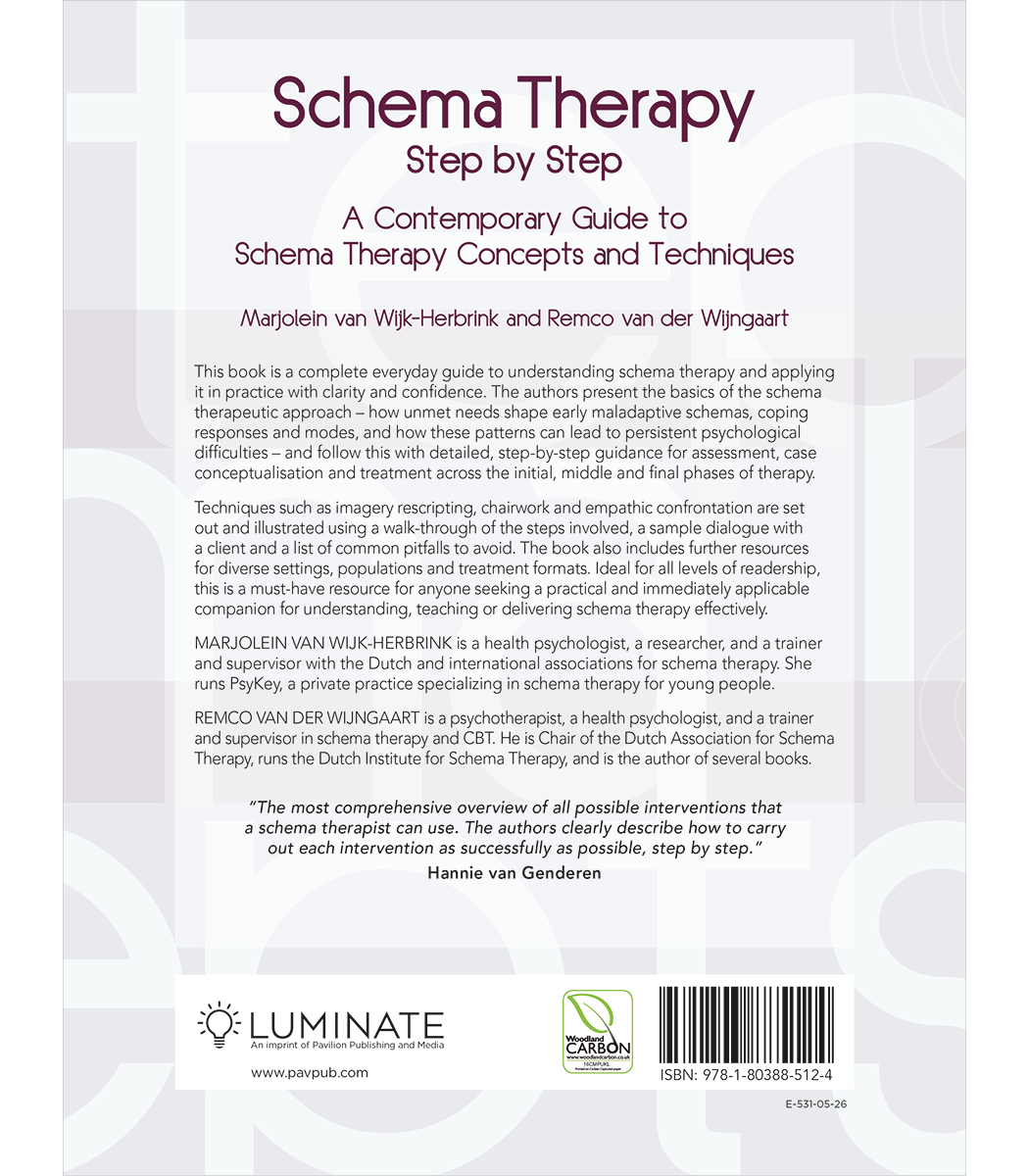
Schema Therapy Step by Step is a practical guide to understanding schema therapy and applying it with clarity and confidence. The authors explain the basics of schema therapy theory – how unmet core emotional needs shape early maladaptive schemas, coping responses and modes, and how these patterns lead to longstanding psychological difficulties. They also provide detailed descriptions of schemas, modes and emotional needs, alongside step-by-step guidelines for assessment, case conceptualisation and treatment across the initial, middle and final phases of therapy.
Techniques such as imagery rescripting, chairwork, cognitive restructuring and behavioural change are illustrated through therapist–client dialogues and three running case studies. The book also offers worksheets, mode models, safety plans and adaptations for diverse populations, settings and treatment formats including adolescents, groups and clients with intellectual disabilities.
Read sample below.
Audience
Schema Therapy Step by Step is for novice and trainee therapists looking for an introduction to schema therapy; accredited schema therapists seeking an up-to-date resource for clinical practice; mental health practitioners (e.g. psychotherapists, psychiatrists, counsellors) interested in the latest treatment approaches and integrative psychotherapy; students, researchers and leaders in psychology, education and psychotherapy.
Content
Preface and Acknowledgements
Foreword
PART I: General Overview
Chapter 1: Introduction
Chapter 2: Overview of Concepts
PART II: Assessment Phase
Chapter 3: Diagnostic Imagery
Chapter 4: Creating a Timeline
Chapter 5: Downward Arrow Technique
Chapter 6: Diagnostic Chairwork
Chapter 7: Dialogue with a Coping Mode
Chapter 8: Interpreting and Providing Feedback on Questionnaire Scores
Chapter 9: Case Conceptualization
Chapter 10: Creating a Mode Model
Chapter 11: Setting Goals and Creating a Treatment Plan
PART III: Treatment Phase – Working with Child Modes
Initial Phase
Chapter 12: Providing Care to the Vulnerable Child (Limited Reparenting)
Chapter 13: Offering Guidance (Limited Reparenting)
Chapter 14: Limit Setting for the Undisciplined/Impulsive Child
Chapter 15: Validating the Angry Child
Chapter 16: Creating a Safety Plan
Middle Phase
Chapter 17: Stimulating the Angry Child
Chapter 18: Stimulating the Happy Child
Chapter 19: Chairwork with the Undisciplined/Impulsive Child
Chapter 20: Chairwork – Practising Empathy for the Vulnerable Child
Final Phase
Chapter 21: Chairwork – Warm Letter to the Vulnerable Child
Chapter 22: Empathic Confrontation with the Vulnerable Child
PART IV: Treatment Phase – Working with Inner Critic Modes
Initial Phase
Chapter 23: Imagery Rescripting – The Therapist Rescripts
Chapter 24: Chairwork with the Demanding Critic
Chapter 25: Chairwork with the Punitive Critic
Middle Phase
Chapter 26: Imagery Rescripting – Rescripting Together
Chapter 27: Chairwork with an Inner Critic Mode in the Middle Phase
Chapter 28: Visualizing and Combatting an Inner Critic Mode
Chapter 29: Historical Role Play
Chapter 30: Cognitive Technique – Continuum Technique
Chapter 31: Cognitive Technique – Courtroom Method
Chapter 32: Cognitive Technique – Pie Slice
Chapter 33: Replacing Critical Messages with Realistic Ones
Final Phase
Chapter 34: Imagery Rescripting – The Client Rescripts
Chapter 35: Chairwork with an Inner Critic Mode in the Final Phase
Chapter 36: Empathic Confrontation with an Inner Critic Mode
PART V: Treatment Phase – Working with Coping Modes
Initial Phase
Chapter 37: Empathic Confrontation with a Coping Mode
Chapter 38: Acute Limit Setting for Bully and Attack Mode
Chapter 39: Chairwork with Coping Modes
Chapter 40: Visualizing the Coping Mode
Middle Phase
Chapter 41: Step-by-Step Limit Setting
Chapter 42: Chairwork with Coping Modes in the Middle Phase
Final Phase
Chapter 43: Chairwork with a Coping Mode in the Final Phase
PART VI: Treatment Phase – Working with Healthy Modes
Initial Phase
Chapter 44: Mode Sequence
Chapter 45: (Audio) Flashcard
Chapter 46: Cognitive Techniques – Circle Diary
Middle Phase
Chapter 47: Visualizing the Healthy Adult
Chapter 48: Practising Setting Boundaries
Chapter 49: Evaluating Treatment with the Line Exercise
Chapter 50: Mode Meeting
Chapter 51: Cognitive Behavioural Therapy Techniques
Final Phase
Chapter 52: Chairwork with the Three Chairs of the Healthy Adult
Chapter 53: Future-Oriented Imagery
Chapter 54: Concluding Therapy – Relapse Prevention Plan and
Saying Goodbye
Flashcard Schema Therapy
Delve Deeper into Schema Therapy
Authors
Marjolein van Wijk-Herbrink is a registered psychologist, and a supervisor and trainer with the Dutch and international associations for schema therapy. She is also an EMDR practitioner and CBT therapist. She provides therapy to young people and adults, and she also manages PsyKey, her own private schema therapy practice.
Remco van Der Wijngaart is a psychologist, psychotherapist and educator specialising in schema therapy. He worked for twenty years in an academic department of a mental health institution, participating in treatment studies across a wide range of disorders. He is currently a therapist, trainer and supervisor in CBT and schema therapy in private practice. He has been trained by Jeff Young, Aaron Beck, and Joan Farrell, is Chair of the Dutch Register for Schema Therapy, and is a former Vice President of the International Society of Schema Therapy.
Details
Publisher: Luminate an imprint of Pavilion Publishing and Media Ltd
ISBN: 9781803885124
Publication Date: June 2026





Reviews
There are no reviews yet.