Description
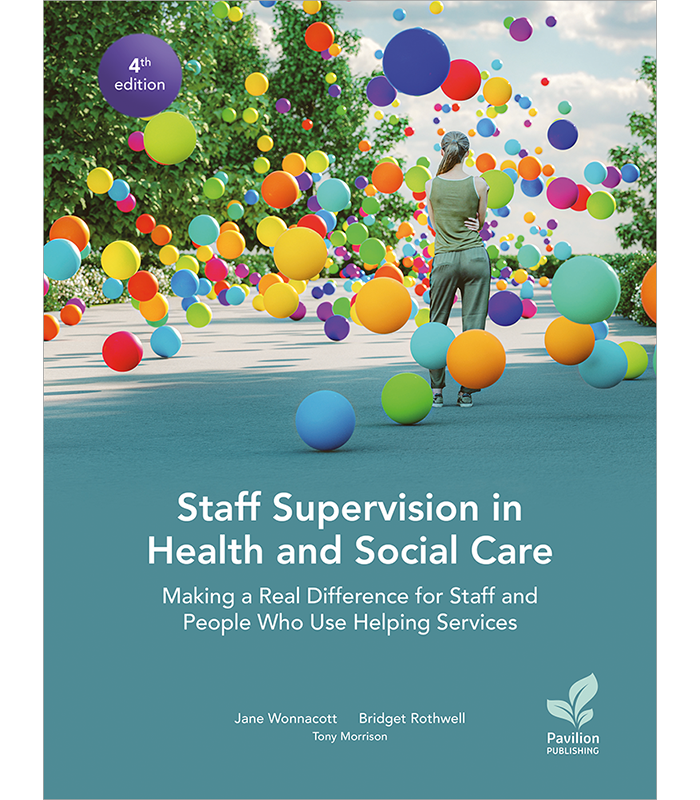
Staff Supervision in Health and Social Care: A fully revised fourth edition of Tony Morrison’s bestselling Staff Supervision in Social Care, has been updated for the challenges faced by today’s helping professionals. This new edition builds on Tony Morrison’s pioneering legacy and incorporates new developments and tools. It is a landmark publication for the contemporary supervision field.
The material is underpinned by the belief that the way in which an organisation supervises and supports its staff is critical to improving the quality of the service it provides. And the level of supervision delivered must be good to benefit all.
The 4th Edition sets out the proven IMS (Integrated Model of Supervision), incorporating four stakeholder groups, four interrelated purposes and a four-stage reflective cycle – the 4x4x4 model.
Like its predecessors, the 4th Edition contains a wealth of information, guidance, research, practical frameworks, action learning exercises and supervision tools.
Audience
Staff Supervision in Health and Social Care: Making a Real Difference for Staff and People Who Use Helping Services will be useful for experienced and novice supervisors across the health and social care spectrum and beyond, both in the UK and internationally. The book also contains specific guidance for those receiving supervision who wish to get maximum benefit from it.
Authors
Jane Wonnacott qualified as a social worker in 1979. In 1994 she founded In-Trac, a training provider of staff in social care, health and education. She has a long interest in supervision and has trained supervisors across the UK. With Tony Morrison, she co-wrote the Children’s Workforce Development Council’s guide for supervising social workers during their early development. She is the author of Developing and Supporting Staff Supervision (Pavilion, 2014).
Bridget Rothwell is an independent social care trainer based in Scotland. She has been a learning and development professional for two decades, following social work practice and a career in management in both public and third sectors. As a facilitator, she has worked across sectors and with a wide range of professions.
Tony Morrison was a leading figure in social care, particularly respected for his work on supervision, interdisciplinary collaboration and staff development.
Content
1. The organisational context
Why supervision matters
Culture and climate
How supervision impacts service outcomes
The factors needed to make supervision work
2. The Core Model
The applicability of the IMS (Integrated Model of Supervision) – An overview of the whole model
Building the model from its three core elements
3. What We Bring to Supervision
What supervisors bring to supervision
Power and authority
Emotional intelligence
Containment
Identity
Adult Attachment frameworks
4. Contracts and Structures
The benefits of a supervision contract
How to negotiate a contract
Supervision and authority
supervision across professions and settings
5. Supervising Practice
Supporting relationship-based practice
Working with bias
Enabling curiosity
Uncertainty
Supporting critical analysis
The six-stage model
6. Making the most of supervision
Helping supervisees prepare for supervision
The IMS seen from the supervisee’s perspective
Details
Publisher: Pavilion Publishing and Media Ltd
ISBN: 9781803884363
Publication date: 17th November 2025



Monalesia Earle, PhD, Independent Researcher and published author –
Jane Wonnacott and Bridget Rothwell breathe new life into health and social care supervision models, not by ignoring or discarding the fundamentals of the craft, and yes, supervision is indeed a craft, but by expanding upon frameworks that speak to the needs of more contemporary thinkers. In ways that should excite the imagination and keep practitioners invested in the important work they do, the authors introduce a new meaning to the phrase: “professional curiosity.” I highly recommend this book for anyone who believes that supervision is the engine that drives us all to do our best work.
Sue Lightbown, Freelance Consultant, Practice Teacher/Educator, Coach, Mentor & Supervisor for Health and Social Care –
Social Work is not easy and nor should it be. Social work supervision should be quality supervision, it should have impact and contribute to a better understanding of outcomes for all. As a practitioner, manager, head of service, practice teacher, independent practitioner/supervisor/coach for more than 40 years, I can say with confidence and understanding that there is real value in this updated version of the original: Staff Supervision in Social Care (2005).
If you know the work of the late, Tony Morrison you will know that he was a knowledgeable and generous professional. He was a leader and advocate for quality social work practice. He spoke with wisdom that had resonance across all disciplines, he knew practice and shared with generosity. The 2005 manual was a seminal text, promoting a quality of supervision that was meaningful, underpinned by knowledge and research, and providing you with insight into what works and why. Attending his training in 2006, listening to him, experiencing and being present, brought me empowerment and joy that I did not expect. For twenty years the original text has informed and strengthened my practice and I strive to share that joyfulness and empowerment.
So you may ask – why do we need an updated version? Because Social Work constantly evolves; and as professionals we need up to the minute guidance on the professional, personal and organisational issues that have impact. Quality supervision and how we facilitate this is key.
As supervisors we must evaluate our own practice, striving always to be knowledgeable and in the moment rather than stay stuck in old habits without even realising it. The authors of the 2026 update have accomplished this. The manual is just what I wanted it to be, sharp, insightful, full of refreshing insight and a fluency that sets into context what we as supervisors should be focusing on going forward. Understanding the range of knowledge required by practitioners (whatever stage of their career) the theoretical perspectives of good practice, cultural knowledge, demonstrating reflection that is meaningful, with critical analysis, recognising and valuing difference and identity, working across value systems and specialisms, the nuance of language, honing our communication skills, observation, listening and hearing are all to the fore, and set out with frameworks that are eminently usable.
Most of all the authors have maintained and added to the accessibility and vitality of the original – I can hear Tony’s voice on every page. In the generosity of this manual you will find something that speaks to you and your practice, enabling you to move forward in your supervisory skills, empowering you without unnecessary cost to your time, and contributing positivity to the ever changing landscape of social work practice.